fish: a dorado, a wahoo and a yellow fin snapper (we think), all of which made great meals. We also
hooked, but failed to land, ten other fish, including a good sized tuna which we lost
at the
boat. We really are very amateur fishermen.
On the ninth day out, our wind diminished considerably. The sailing was actually pretty
delightful and we used the time and easier motion of the boat to do some tasks, like laundry. Garry had a
brand new package of underwear taken from his luggage (apparently during the inspection process) on the trip
from New York. So he did his laundry and vowed never to take new, unopened packages of anything on future trips.
Light air meant changing sails to keep the boat moving. Not only did the wind get light, but
it changed direction frequently and we found ourselves jibing often, using the drifter and using all three
sails downwind. We used our Monitor wind vane, which we dubbed "Bob", to steer most of the way and "Bob" did a
great job. At one point, we were smacked broadside by an enormous wave and Bob lost control of the boat, but
we simply switched to "Otto", our autohelm, until Bob was able to get his head back on straight and continue.
We used very little diesel on this trip. On only two nights did we switch on the motor to get
to the wind, and those were nights when the wind velocity was 0 to 5 and the waves were still big enough to roll
us from side to side. Motoring in those conditions meant that the off-duty watch rested a little more comfortably.
We did have to run the motor two hours a day to keep our batteries charged.
We strictly adhered to all safety rules. We ran with our tri-color light on at night so that
other ships could see us. We maintained a watch in the cockpit at all times. We wore our life vests and harnesses
on watch and never went forward or out of the cockpit without them and without another person on deck.
We were in contact with a group of other boats who were also crossing and it was great to be able
to talk with them twice a day. We also talked each evening with Herb Hilgenberg, "Southbound Two", who routed us
around light air and bad weather. We checked in with Trudy in Barbados each noon and it was a delight to talk
with her and receive her weather reports. We feel as though all of these folks were on the crew, helping us to
make this passage a very good one.
We had no breakdowns of equipment and everything went so smoothly, thanks to Tom's diligent
attention to detail and planning.
As we approached Martinique, Tom was mourning the end of a great sailing trip and Garry and I
were looking forward to
getting to land -- he to see Lorraine and I to get a good night's sleep on a non-moving surface. Our last meal at
sea was a grilled wahoo and some steamed carrots with a hint of tarragon.
We pulled into Martinique, explored the harbor at St. Anne, and were anchored at 2 pm.
We had a wonderful crossing, accomplished with the help of wonderful people, including Herb
and Trudy, everything worked as we planned that it would. We were very fortunate. Many of our friends who have
sailed in the Pacific Ocean have told us that sailing in the Atlantic is so much harder than sailing in the
Pacific. Is the Pacific another horizon for us? We'll sail a little in the Caribbean before making any decisions.
Venezuela
- Steve Budde and Deborah Reichert
S/V ARGO, V42-154
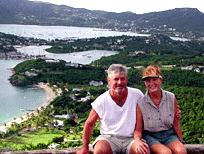
We arrived in Parlamar, Margarita, an island off the north coast of Venezuela. We were here
in the Fall 2003 for six weeks, so have seen and done this island already. The attraction to Margarita
is that it is duty free, in fact,
Venezolanos come here from the mainland to stock up. Our priorities are set: Buy beer (US$3.50/case), wine
($3.50/bottle), rum ($2/bottle) and other liquor, excellent quality "lomitos" filet mignon ($3.80/lb.), diesel
($0.28/gal.), quality reading glasses (hate getting older eyes), and miscellaneous consumer goods. We are
ready to leave six days after catching up with various friends here.
A day sail takes us to Isla Coche, once home to thriving pearl beds in the 1500s. It is an
odd little island, with bare red cliffs at one end, some kind of mining in the middle and a "resort" at the
other end -- supposedly Europeans like to holiday here, not sure why, although there were enough kite-boarders
here to make it look popular.
At 5 am, departure in the dark gave us a day sail (motor) to Puerto La Cruz on the north
coast of mainland Venezuela. A group of dolphins greeted us with sunrise, only to return six hours later
(one was recognizable with a 3-inch scar on it's left "shoulder"). Although not enough wind to sail, the day
was beautiful with gorgeous skies, as we went past many islands and along the coast. It was like sailing
through Colorado and New Mexico: High mountains, some with bar red-rock cliffs, others plentiful with green
trees -- truly breathtaking!
We arrive at the Bahia Redonda Marina in Puerto La Cruz (near Barcelona) greeted by our
good friends from Houston, Bob and Susan, S/V SUNRISE. They have been here for a year now. Wonder why? Perhaps
it could be the free dockside electricity ... or the free dockside water ... or dockside air conditioning ... or
cable TV ... or wireless internet right on the boat ... or the free worldwide phone calls from the boat
(www.skype.com -- it's free) ... or the cheap, cheap cost of living here ... or all the other cruisers
that have been here forever, too . or . . You get the picture.
Although all those things are very enticing, we plan to be here only a couple of months to
do some island traveling (Venezuela is as varied a country as the US) and to do our routine annual medical exams.
Venezuelan health care is excellent, with state-of-the-art equipment / facilities and high-trained,
English-speaking physicians, not to mention